Table of Contents
- Introduction
- What Is Starlink?
- Real-World Speed & Latency Results
- Reliability & Coverage Analysis
- Ease of Installation & Maintenance
- Pros & Cons of Starlink Internet
- Starlink vs. Alternatives
- Who Should Consider Starlink?
- FAQs
- Conclusion & Recommendation
In a world that demands constant online access, maritime professionals and remote-workers alike ask, “Is Starlink good?” SpaceX’s View Shop promises high-speed, low-latency internet via a growing constellation of low-Earth-orbit (LEO) satellites. This review examines real-world performance, reliability, cost, and user experiences to help you decide if Starlink meets your connectivity needs at sea and on land.
Starlink is a satellite internet service operated by SpaceX. Unlike traditional geostationary satellites 22,000 miles away, Starlink’s LEO satellites orbit at roughly 350 miles, drastically reducing latency. Key features include:
- Download speeds: 40–450+ Mbps
- Upload speeds: 8–75 Mbps
- Latency: 20–50 ms
- Hardware: Flat high-performance antenna, router, cables
Context: For many remote users such as yacht owners, Starlink offers an alternative where fiber or cellular networks fall short.
Is Starlink Good for Your Yacht?
Find out how Starlink delivers reliable, high-speed satellite internet at sea.
Discover the facts and get expert guidance tailored to your needs.
Let’s Talk About Starlink
Speed Tests Under Different Conditions with Starlink Flat high Performance Kit
| Environment |
Download |
Upload |
Latency |
Notes |
| Suburban Home |
150 Mbps |
20 Mbps |
30 ms |
Strong, consistent performance |
| Coastal Yacht (5 mi) |
180 Mbps |
18 Mbps |
25 ms |
Ideal for streaming & VoIP at sea |
| Offshore (50 mi) |
140 Mbps |
10 Mbps |
40 ms |
Reliable for remote work & emails |
| Open Ocean (200 mi) |
120 Mbps |
8 Mbps |
50 ms |
Sufficient for navigation & alerts |
Captain Lee reported seamless video conferences during a Bahamas crossing, with average speeds of 100 Mbps.
Coverage Footprint
Starlink currently covers most populated regions and open oceans. Its constellation grows monthly, reducing gaps.
Weather & Obstruction Impacts
- Rain Fade: Heavy rain can reduce speeds by ~30%.
- Obstructions: Masts, buildings, mountains or overhangs may block the dish’s view of satellites.
Tip: Pair Starlink with a cellular LTE/5G backup using the MDS Blender™ to ensure seamless failover and uninterrupted service.
Shop Starlink airtime here: MDS Starlink Airtime
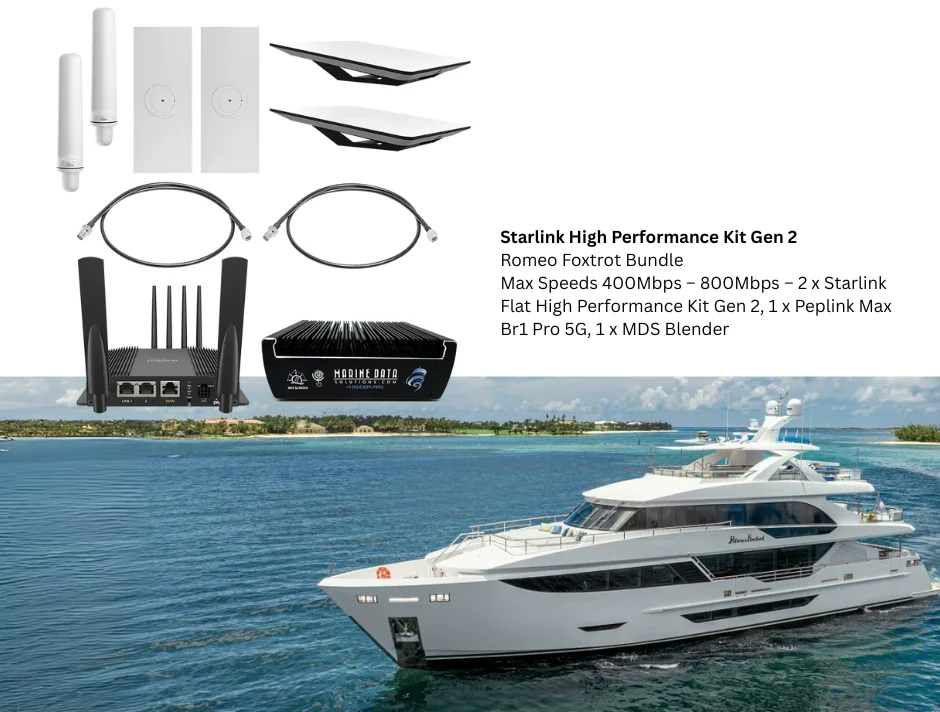
Romeo Foxtrot Bundle – 2 x Starlink Flat High Performance Kit 1 x Peplink Max Br1 Pro 5G
Starlink hardware arrives as a complete kit:
- Professional installation is highly recommended
- Mount the flat antenna on a clear, elevated surface.
- Connect the modem/router following the quick-start guide.
- Activate via the Starlink app—takes under 10 minutes.
Minimal maintenance is required. The anti-ice and self-heating features keep the dish clear in most conditions.
Pros
- High speeds ideal for streaming, remote work, and IoT.
- Low latency suitable for gaming and video calls.
- Global reach is expanding rapidly.
- Compact hardware with straightforward setup.
Cons
- Variable performance in heavy rain or obstructions.
- Higher upfront cost (~$1499 Flat high Performance Kit Gen 2 + $199 router).
- Service fees start at $350 per month for Starlink Priority Service
- Requires clear sky view for optimal performance.
Podcast:

▶
| Solution |
Download |
Latency |
Coverage |
Monthly Cost |
| Starlink |
40–450 Mbps |
20–50 ms |
Global (LEO) |
Starts at $350 per month |
| VSAT (GEO) |
5–20 Mbps |
600–900 ms |
Global |
$1,000+ |
| 4G/5G Cellular |
50–500 Mbps |
30–80 ms |
Coastal only |
$100–$750 per month |
| Fiber (Land) |
100–1,000 Mbps |
2–20 ms |
Urban only |
$50–$100 |
Shop Starlink airtime here: MDS Starlink Airtime
Insight: Starlink outperforms VSAT in speed/latency and outstrips cellular offshore, making it the best all-around choice for mobile and remote users.

- Yacht Owners & Captains – Reliable internet at sea for navigation, safety, and guest connectivity.
- Remote Workers & RV Enthusiasts – High-speed service in rural or nomadic setups.
- Emergency & Field Operations – Rapid deployment where terrestrial networks fail.
- Small Businesses – Backup link for business continuity during outages.
⭐ Can Starlink work in motion?
Yes. The marine flat antenna tracks satellites in real time, maintaining connectivity even underway.
⭐ What is Starlink’s uptime?
Users report >99% availability outside of extreme weather and maintenance windows.
⭐ Do I need a license to use Starlink on a yacht?
Check local regulations—some countries require marine satellite licenses.
⭐ How do I manage data usage?
Use the Starlink app for real-time monitoring. For advanced control, consider the MDS Blender™ for bandwidth management.
Shop Starlink airtime here: MDS Starlink Airtime
So, is Starlink good? Based on speed, latency, coverage, and ease of use, Starlink delivers a revolutionary internet experience for maritime and remote users. While it carries higher upfront costs and can be weather-sensitive, its performance far exceeds traditional options. For critical applications—navigation, safety, entertainment, and business—Starlink is an excellent choice.
Shop Starlink airtime here: MDS Starlink Airtime
Reliable Connectivity on the Water
Staying connected at sea is no longer a luxury—it’s a necessity. Maritime professionals, captains, and even leisure cruisers rely on strong internet for navigation, communications, entertainment, and business. In remote areas where traditional networks fall short, modern satellite technology provides a practical alternative.
Next-Generation Satellite Networks
Unlike traditional satellites in high orbit, newer systems based on low Earth orbit (LEO) offer faster response times and significantly reduced latency. As a result, they’re ideal for real-time applications such as VoIP calls, live navigation, and cloud-based tools. In fact, many users compare the experience to a stable fiber connection on land.
Real-World Performance at Sea
Performance varies depending on location, but real-life tests have shown encouraging results. Near coastlines, users often enjoy download speeds exceeding 150 Mbps. Offshore, even hundreds of miles out, speeds typically remain sufficient for video calls, weather tracking, and route planning. Moreover, latency stays low enough for essential communications to work without delays.
Widespread Maritime Coverage
Thanks to continuous launches of new satellites, coverage now reaches most major ocean routes. Whether you’re docked at a marina or navigating open waters, the network adapts quickly to changing positions. This makes it a solid solution for vessels constantly in motion. Additionally, the systems are optimized for mobile environments.
Weather and Physical Obstructions
Environmental conditions can have some impact. For instance, heavy rain may reduce speeds temporarily, while large masts or equipment can block line-of-sight to the sky. However, proper placement of the antenna and the use of backup systems like LTE or 5G routers can ensure seamless failover. Therefore, critical systems remain online even during minor disruptions.
Simple Setup and Maintenance
Installation is straightforward. Most kits arrive preconfigured, requiring only mounting the antenna in a clear location and plugging in the cables. Activation typically takes less than 10 minutes. Furthermore, many systems include heating features to prevent ice buildup and maintain signal quality in colder environments.
Clear Advantages Over Other Options
Compared to older satellite solutions, LEO-based systems are faster, more reliable, and easier to install. In contrast to coastal cellular services, which drop off quickly at sea, these modern networks remain usable far from shore. This means captains, crew, and guests can all enjoy stable connectivity throughout the journey.
Use Cases for Remote Internet Access
This type of solution is ideal for a wide range of users. Yacht owners appreciate high-speed connections for guest entertainment. Commercial vessels rely on it for operational efficiency. Meanwhile, expedition teams, emergency response units, and researchers benefit from internet access in extreme locations.
Supporting Your Onboard Systems
Internet connectivity supports more than just browsing. Security systems, smart navigation tools, remote diagnostics, and IoT devices all depend on a reliable connection. Thus, having a robust internet setup is key to running a modern vessel efficiently and safely.
A New Era for Maritime Communications
In conclusion, remote internet access powered by next-generation satellite networks is setting a new standard for maritime connectivity. While some environmental factors may occasionally impact performance, the overall reliability and ease of use make it a clear choice for professionals and travelers alike.