

- Why a Strong Marine Connection Matters
- What Is a Marine Connection?
- Need a properly designed marine connection system for your vessel?
- Marine Internet Connection for Coastal and Offshore Use
- Common Marine Internet Sources
- Starlink and Satellite Internet for Marine Connection
- LTE/5G as Part of a Marine Connection
- Peplink Marine Connection Systems
- Why Hybrid Marine Connections Are More Reliable
- How to Choose the Right Marine Connection
- Common Marine Connection Mistakes
- Best Marine Connection by Vessel Type
- FAQ: Marine Connection
- Conclusion: Marine Connection
- Best Internet Marine Connection for a Boat Starts Here
- Related Articles:
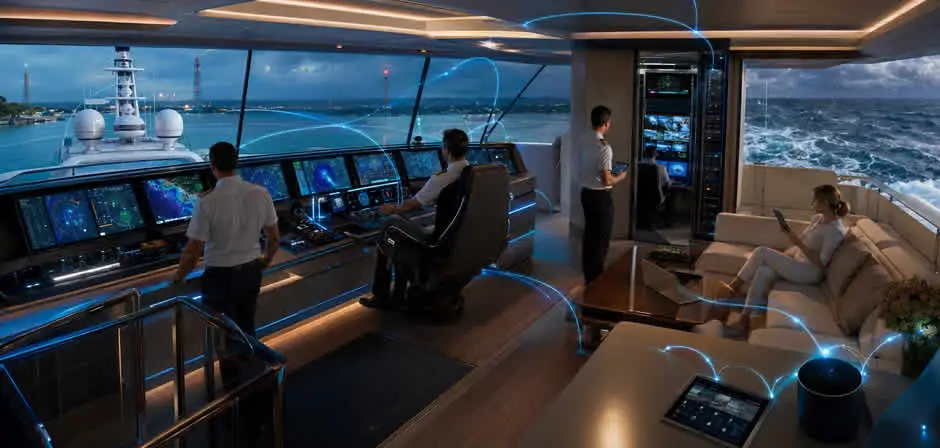
A marine connection is the complete onboard network that keeps a boat or yacht connected through satellite internet, LTE/5G, marina WiFi, routers, antennas, and onboard wireless distribution.
For most serious marine applications, the most reliable setup is a hybrid system that combines:
- Satellite internet offshore
- LTE/5G near shore
- Intelligent routing and failover
- Proper onboard WiFi design
- Professional installation and network management
The mistake many boat owners make is treating marine internet like a home network. It is not.
A vessel moves through changing coverage conditions constantly. What works at the dock may fail ten miles offshore. What works offshore may become unstable inside congested marinas.
Reliable marine connectivity comes from system design, not from buying one piece of hardware.
Why a Strong Marine Connection Matters
Modern vessels depend on internet connectivity far beyond entertainment.
Today’s onboard networks support:
- Navigation and weather data
- Remote vessel monitoring
- Crew communication
- Video conferencing
- Streaming and guest WiFi
- Security systems
- Cloud-based applications
- Operational coordination
- Remote diagnostics and support
The problem is that marine environments are unpredictable.
Signal conditions change continuously because the vessel moves between marinas, coastal zones, offshore regions, and different cellular or satellite coverage areas. A single-source internet setup may appear acceptable at the dock and become unreliable once the vessel starts moving.
This is why professionally designed marine connections focus on:
- Redundancy
- Coverage transitions
- Failover behavior
- Antenna placement
- Traffic prioritization
- Onboard WiFi coverage
- Power stability
- Real-world operating conditions
The objective is not simply internet access.
The objective is maintaining usable connectivity when conditions change.
What Is a Marine Connection?
A marine connection is the complete communication and internet infrastructure onboard a vessel.
That infrastructure may include:
- Satellite internet systems
- LTE/5G cellular systems
- Marina WiFi integration
- Marine routers
- Antennas
- Access points
- VPN systems
- Remote management platforms
- Traffic management software
A properly designed marine network has three primary layers.
1. Internet Source Layer
This is how the vessel connects to the outside world.
Common sources include:
Each source has strengths and limitations depending on location and operating conditions.
2. Network Management Layer
This controls how the vessel uses available internet sources.
Systems such as Peplink, Pepwave, and MDS Blender manage:
- Failover
- WAN prioritization
- Traffic routing
- Bandwidth allocation
- Remote access
- VPN services
- Network segmentation
Without proper network management, even strong internet sources can perform poorly onboard.
3. Onboard WiFi Distribution Layer
This determines whether users onboard actually experience stable connectivity.
Coverage planning matters.
A vessel may have excellent satellite performance while still delivering poor user experience because:
- Access points are poorly positioned
- Cabling is incorrect
- Interference is unmanaged
- Coverage zones were never planned properly
Reliable marine connectivity depends on all three layers working together.
Need a properly designed marine connection system for your vessel?

Marine Internet Connection for Coastal and Offshore Use
The right marine internet connection depends heavily on where the vessel operates.
A boat that remains near shore has different requirements than a yacht operating offshore or internationally.
Nearshore Connectivity
Near shore, LTE/5G is often the most efficient connection source because it provides:
- Lower latency
- Strong speeds
- Lower operating cost
- Good responsiveness for cloud applications
When properly installed with marine-grade antennas and routers, LTE/5G can perform extremely well along populated coastlines and waterways.
The limitation is range.
Cellular coverage depends entirely on land-based infrastructure.
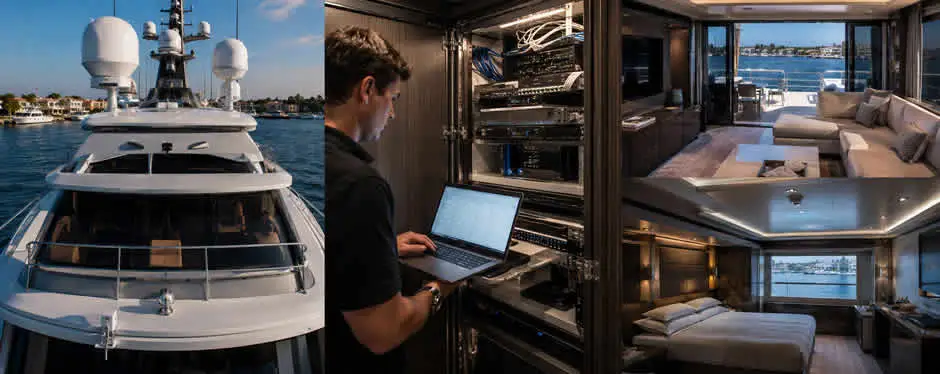
Offshore Connectivity
Once vessels move offshore, satellite systems become essential.
This is where systems such as:
become primary connectivity sources.
Satellite systems allow vessels to maintain internet access beyond cellular coverage areas, but performance depends heavily on installation quality and network management.
Common Marine Internet Sources
| Connection Type | Best Use | Main Limitation |
|---|---|---|
| Marina WiFi | Dockside updates and light browsing | Congestion and inconsistent coverage |
| LTE/5G | Coastal cruising and nearshore operation | Limited offshore range |
| Starlink | Offshore high-speed connectivity | Requires clear sky visibility |
| OneWeb or VSAT | Enterprise-grade offshore redundancy | Higher complexity and cost |
| Hybrid Systems | Serious yacht and offshore use | Requires proper design and configuration |
The most reliable marine connection is usually not one source.
It is a properly managed combination of multiple sources.
Starlink and Satellite Internet for Marine Connection
Starlink has changed marine internet significantly because it provides relatively high-speed satellite connectivity with lower latency than many traditional marine satellite systems.
For many vessels, Starlink has become the primary offshore internet source.
Common applications include:
- Yachts
- Sportfish vessels
- Charter vessels
- Cruising sailboats
- Expedition vessels
- Commercial marine operations
However, Starlink alone does not guarantee a reliable marine connection.
This is where many installations fail.
Poor performance is often caused by:
- Obstructed antenna placement
- Incorrect mounting locations
- Weak onboard WiFi
- Poor power quality
- Incorrect service plans
- Lack of failover configuration
- Overloaded guest traffic
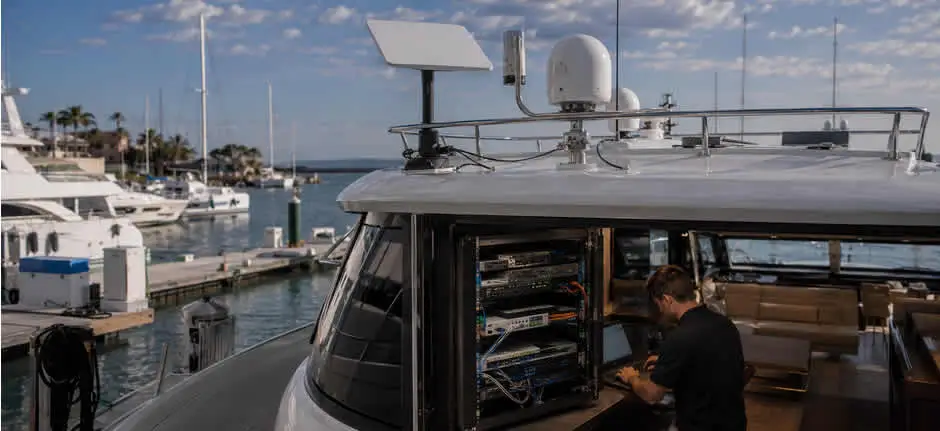
The antenna is only one part of the system.
For serious marine use, Starlink performs best when integrated into a properly designed onboard network.
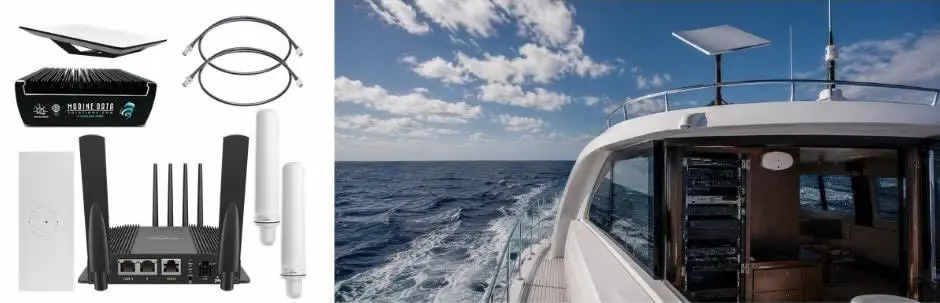
Shop MDS Starlink Flat High Performance Kit Gen 2 Video Conference Bundle
LTE/5G as Part of a Marine Connection
LTE/5G remains extremely important in marine networking because coastal cellular performance can be faster and more responsive than satellite connections.
A professional LTE/5G setup may include:
- Multi-carrier SIM support
- Marine-grade antennas
- External antenna mounting
- Dedicated cellular routers
- Automatic failover systems
- Traffic prioritization
Near shore, LTE/5G often becomes the preferred connection because it can reduce satellite usage while improving responsiveness for real-time applications.
Offshore, satellite typically becomes primary again.
This transition should happen automatically.
Users onboard should not have to manually reconnect every time coverage conditions change.
Podcast:

Peplink Marine Connection Systems
A Peplink marine connection uses Peplink or Pepwave routing hardware to manage multiple internet sources onboard.
This allows the vessel to intelligently transition between:
Peplink systems are widely used in marine environments because they support:
- Automatic failover
- Multi-WAN routing
- SpeedFusion bonding
- WAN smoothing
- Traffic prioritization
- Remote access
- VPN connectivity
- Bandwidth control
This becomes important because many modern applications do not tolerate interruptions well.
Video calls, cloud applications, remote monitoring systems, and streaming services can fail quickly when connectivity changes are not managed correctly.
The router layer is what turns multiple internet sources into a functional marine network.
Example
A yacht leaving Fort Lauderdale may operate across three different internet conditions during a single trip:
- Marina WiFi at the dock
- LTE/5G near shore
- Starlink offshore
Without intelligent routing, users onboard would constantly lose connectivity during those transitions.
A properly configured marine router handles those transitions automatically.
That is the difference between installing internet hardware and designing a marine connection system.
See how Starlink, LTE/5G, and intelligent routing can work together onboard your vessel.
Request a custom marine connection plan.

Why Hybrid Marine Connections Are More Reliable
Single-source marine internet systems fail more often because every connection type has limitations.
Satellite systems can experience obstruction.
Cellular coverage fades offshore.
Marina WiFi becomes congested.
Hybrid marine connections reduce these weaknesses by combining multiple connection sources into one managed system.
A hybrid setup may include:
- Starlink for offshore operation
- LTE/5G for coastal use
- Marina WiFi at the dock
- OneWeb or VSAT for redundancy
- Peplink or MDS Blender for routing and failover
- Dedicated onboard WiFi access points
The goal is continuity.
Not simply speed.
Professional marine networks are designed so connectivity continues operating even when conditions change.
How to Choose the Right Marine Connection
The correct marine connection depends on:
- Vessel size
- Operating region
- User demand
- Offshore requirements
- Guest expectations
- Operational dependency
- Required uptime
A small recreational boat does not require the same infrastructure as a charter yacht or commercial vessel.
Define the Operating Area
Start by identifying where the vessel actually operates:
- Dockside only
- Coastal cruising
- Offshore operation
- International routing
Coverage requirements change dramatically between these environments.
Determine User Demand
There is a major difference between:
- One owner checking email
- Guests streaming simultaneously
- Crew running cloud applications
- Captains downloading weather and routing data
Bandwidth planning matters.
Separate Critical and Non-Critical Traffic
Operational systems should not compete with guest streaming traffic.
A properly configured network prioritizes:
- Navigation support
- Monitoring systems
- Operational communication
- Business applications
before entertainment traffic.
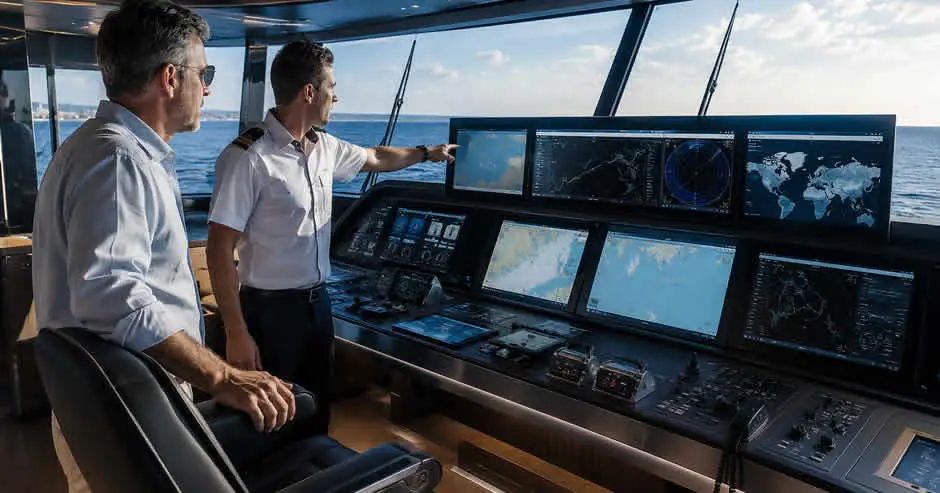
Design the Full Network
The most common mistake is buying equipment before planning the network architecture.
Reliable marine internet requires:
- Correct antenna placement
- Proper routing
- Stable power
- Planned WiFi coverage
- Network segmentation
- Redundancy
Skipping these steps usually creates ongoing reliability problems later.
Common Marine Connection Mistakes
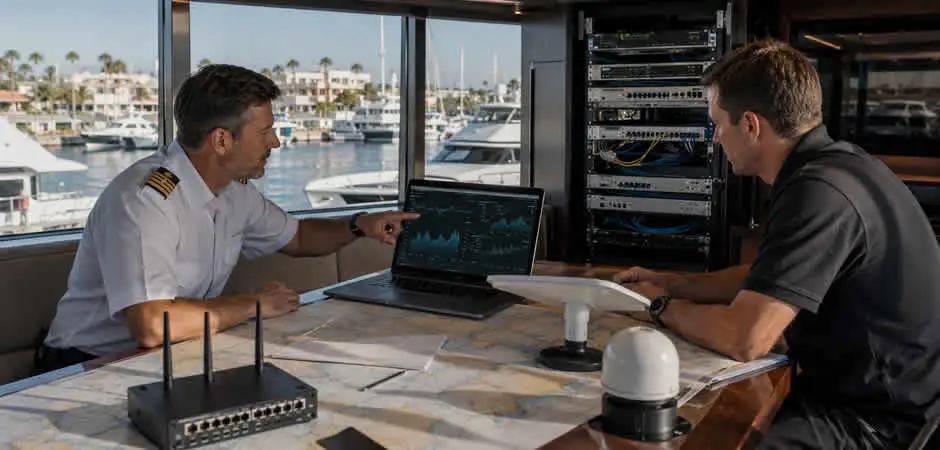
Most marine internet problems are not caused by the service provider.
They are caused by poor system design.
Common mistakes include:
- Relying only on marina WiFi
- Expecting LTE to work offshore
- Installing Starlink with partial obstruction
- Using consumer-grade networking hardware
- Ignoring onboard WiFi coverage planning
- Mixing guest and operational traffic
- Skipping failover configuration
- Poor cable routing and power protection
- No remote monitoring capability
A strong satellite connection can still feel unreliable onboard if the network itself is poorly designed.
Best Marine Connection by Vessel Type
| Vessel Type | Recommended Marine Connection |
|---|---|
| Small day boat | LTE/5G router or Starlink Mini |
| Weekend cruiser | Starlink with LTE/5G backup |
| Sportfish vessel | Starlink Performance with marine router |
| Charter yacht | Starlink + LTE/5G + Peplink or MDS Blender |
| Offshore yacht | Multi-source satellite + LTE/5G + managed routing |
| Commercial vessel | Redundant satellite + cellular + enterprise routing |
The correct solution depends on how the vessel actually operates.
Overbuilding wastes money.
Underbuilding creates reliability problems.
FAQ: Marine Connection
⭐What is a marine connection?
A marine connection is the onboard communication and internet system that keeps a vessel connected using satellite internet, LTE/5G, marina WiFi, routers, antennas, and onboard wireless distribution.
⭐What is the best marine connection for a boat?
For most serious marine applications, the best marine connection is a hybrid system that combines satellite internet offshore, LTE/5G near shore, and intelligent routing with automatic failover.
⭐Is Starlink a good marine connection?
Yes. Starlink is one of the strongest offshore internet options currently available for boats and yachts. However, installation quality and network integration matter significantly.
⭐How far offshore does marine internet work?
Cellular internet depends on tower range and is limited offshore. Satellite systems can operate much farther offshore when coverage, hardware, and service plans are configured correctly.
⭐Do I still need LTE/5G if I have Starlink?
Usually yes.
LTE/5G is often faster and lower latency near shore. It also provides valuable redundancy when satellite coverage is obstructed or congested.
⭐What does Peplink do onboard?
Peplink manages multiple internet sources onboard and automates failover, traffic routing, bandwidth control, VPN access, and network prioritization.
⭐Why is my boat internet unreliable?
Unreliable marine internet is commonly caused by poor antenna placement, weak onboard WiFi coverage, improper routing configuration, lack of failover, or relying on a single connection source.
Key Takeaways: Marine Connection
- A marine connection is a complete onboard network, not a single device.
- Reliable marine internet depends on proper system design.
- Hybrid systems are usually more dependable than single-source setups.
- Starlink works best when integrated into a managed onboard network.
- LTE/5G remains extremely valuable near shore.
- Routing, failover, and onboard WiFi distribution matter as much as the internet source itself.
- Poor installation is one of the most common causes of marine connectivity problems.
- Professional network planning improves reliability, usability, and uptime.
Conclusion: Marine Connection
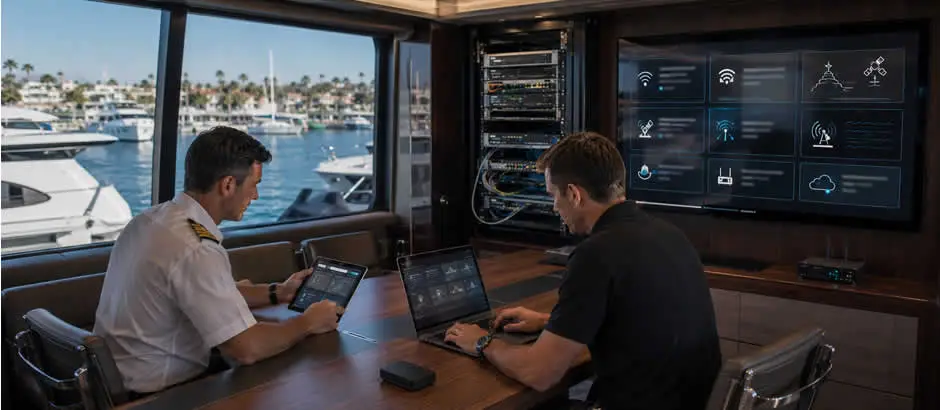
Reliable marine connectivity is built through proper network design, not through a single product purchase.
The vessels that consistently maintain stable internet offshore and near shore are usually the ones built around layered connectivity:
- Satellite internet
- LTE/5G
- Intelligent routing
- Redundancy
- Proper onboard WiFi coverage
- Professional installation
For smaller recreational boats, a simple setup may be enough.
For yachts, charter operations, offshore sportfish vessels, and commercial marine applications, hybrid systems are typically the more reliable long-term solution.
When designed correctly, a marine connection supports communication, operations, remote work, monitoring, entertainment, and onboard user experience across changing marine environments.