
Satellite Internet for Yachts in Florida
Yachts operating between South Florida, the Bahamas, and the Caribbean need more than one internet source. Near shore, LTE/5G can provide strong performance when coverage is available. Offshore, Starlink and other satellite systems become the primary internet source.
Marine Data Solutions designs yacht internet systems that combine these available WAN sources into one managed onboard network so captains, owners, crew, and charter guests are not dependent on a single connection.
Why Yacht Internet in Florida Requires More Than One Internet Source
A yacht may use marina WiFi while docked, LTE/5G while operating near shore, and Starlink once it moves beyond dependable cellular coverage.
The challenge is not simply getting internet onboard. The challenge is designing the network so these different sources can be used intelligently as the vessel moves between Fort Lauderdale, the Florida Keys, the Bahamas, and offshore cruising areas.
A properly designed yacht internet system should also separate operational, crew, owner, and charter-guest traffic so heavy streaming or downloads do not interfere with more important vessel communications.


How Does Satellite Internet Work on a Yacht?
Satellite internet allows a yacht to stay online beyond the range of terrestrial cellular networks by communicating directly with satellites.
Modern Low Earth Orbit systems such as Starlink provide much lower latency and substantially higher throughput than older GEO satellite systems, making them practical for video calls, streaming, remote work, cloud applications, and general onboard internet use.
Performance can still be affected by antenna obstruction, heavy rain, vessel movement, network demand, and the quality of the onboard network. For that reason, larger yachts often combine satellite internet with LTE/5G and other available WAN sources rather than relying on one connection alone.
Contact Marine Data Solutions for a Yacht Internet Evaluation.
What a Professional Yacht Internet System Should Include

Satellite Internet for Offshore Use
Starlink or another appropriate satellite service provides the primary internet source once the vessel moves beyond dependable cellular coverage.

LTE/5G for Nearshore Use
Marine LTE/5G can provide strong performance near shore and may reduce unnecessary satellite-data usage when suitable cellular coverage is available.

Managed Onboard Network
A professional yacht internet system should integrate the available WAN sources with onboard WiFi, VLANs, traffic management, and automatic failover.
Technical Support and Remote Management
Marine Data Solutions can remotely manage supported systems and provide technical support when the vessel is away from its home dock.
Why Florida and Bahamas Cruising Requires a Hybrid Yacht Internet System
A yacht leaving Fort Lauderdale may move from marina WiFi to LTE/5G, then beyond cellular range into Starlink or another satellite service, often within the same trip.
A properly engineered network can manage these changing WAN sources automatically. The objective is to reduce user-visible interruptions and avoid requiring the captain or crew to manually reconfigure the network every time the vessel changes operating area.
Example: Fort Lauderdale to the Bahamas
A yacht departing Fort Lauderdale may begin the trip using marina WiFi or LTE/5G. As the vessel moves offshore and cellular coverage weakens, Starlink becomes the primary internet source.
Once in the Bahamas, satellite internet generally remains the primary WAN connection, while local cellular service can be added where appropriate.
When these sources are integrated through a managed yacht network, the transition between WAN connections can occur automatically without requiring the crew to manually switch the entire vessel from one internet source to another.
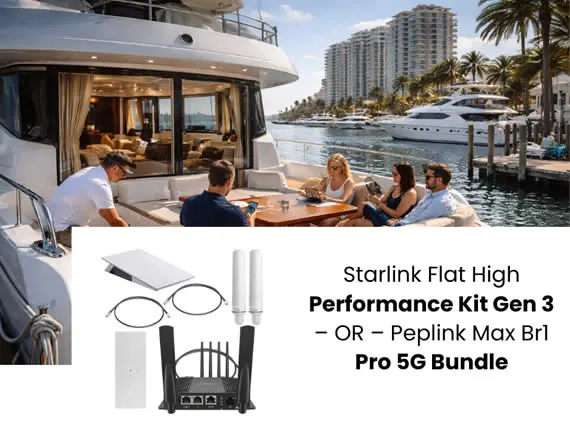
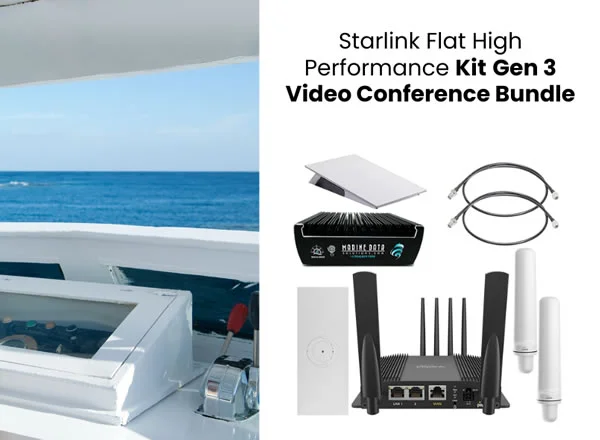
Is Satellite Internet a Good Primary Internet Source for a Yacht?
Yes. Modern LEO satellite internet has become a primary internet source for many yachts, particularly when it is combined with LTE/5G and a properly designed onboard network.
Satellite internet is particularly valuable offshore, where terrestrial cellular coverage is limited or unavailable. However, it should not automatically be treated as the vessel’s only WAN source.
What Satellite Internet Does Well
Satellite internet can support offshore communications, streaming, video conferencing, remote work, cloud applications, software updates, and general internet use while underway.
Limitations to Understand
Satellite internet can experience brief interruptions because of antenna obstruction, heavy rain, vessel movement, network demand, or equipment issues. Applications such as Zoom, Teams, VPNs, and remote desktops are often more sensitive to these brief interruptions than ordinary web browsing or streaming.
Types of Internet Sources Used on Yachts
1. Marine Satellite Internet (Primary Offshore Connectivity)
Marine satellite internet becomes the primary internet source once a yacht moves beyond dependable cellular coverage. Modern LEO systems such as Starlink provide substantially lower latency and higher throughput than traditional GEO satellite systems, making them practical for streaming, video conferencing, cloud applications, remote work, and general onboard internet use.
Performance still depends on antenna placement, weather, obstruction, vessel movement, network demand, and the quality of the onboard network.
2. Maritime LTE / 5G Internet (Best Nearshore Performance)
LTE and 5G can provide very strong performance near shore when suitable cellular coverage is available.
In South Florida and parts of the Bahamas, marine LTE/5G is useful as a primary or supplemental WAN source, but coverage varies significantly by location, carrier, terrain, tower density, and distance from shore.
For professional yacht installations, external marine antennas and properly configured routers are typically used to improve reception and integrate cellular service into the onboard network.
3. Marine WiFi (Dockside Optimization)
Marina or dockside WiFi can be used as an additional WAN source when the vessel is docked and the shore network is reliable.
It can be useful for software updates, large downloads, cloud backups, and other high-data activities. Performance varies widely by marina, network congestion, access-point location, and the quality of the shore-side internet service.

Why a Hybrid Yacht Internet System Works Better
A hybrid yacht internet system combines multiple WAN sources such as Starlink, LTE/5G, marina WiFi, and, where appropriate, other satellite services into one managed onboard network.
The advantage is not that any one connection becomes perfect. The advantage is that the vessel can use the best available source at a given time and maintain alternatives when one source becomes weak or unavailable.
How Hybrid Marine Internet Works
Multiple internet sources feed into a central router or WAN-management system. Depending on the network design, traffic can be routed, balanced, bonded, or failed over between available connections.
If one WAN source becomes degraded or unavailable, the system can shift traffic to another working source. This can reduce user-visible interruptions and improve overall redundancy.
Why This Matters on Yachts
Hybrid network design is especially useful on yachts because applications such as Zoom, Teams, VPNs, and remote desktops can be sensitive to even brief WAN interruptions.
A managed onboard network can also separate operational, owner, crew, and charter-guest traffic so heavy streaming or downloads do not interfere with higher-priority vessel communications.
Marine Data Solutions can use the MDS Blender to combine multiple WAN sources, provide automatic failover, manage bandwidth, and preserve active sessions when one internet source becomes temporarily unavailable.

How Satellite Internet Is Installed on a Yacht
Professional yacht satellite installation starts with antenna placement, cable routing, power requirements, onboard network design, and the vessel’s expected cruising profile.
Antennas should be positioned with the clearest practical view of the sky while considering radar arrays, domes, masts, superstructure, service access, drainage, and cable routes.
The installation should also address how Starlink or other satellite service will integrate with LTE/5G, marina WiFi, onboard access points, VLANs, and WAN failover.
Book a Free Yacht Internet & WiFi Evaluation
Yacht Internet in Florida vs. the Bahamas
Internet conditions change significantly as a yacht moves from South Florida into the Bahamas.
Near the Florida coast, LTE/5G can often provide strong performance. As the vessel moves offshore, satellite internet becomes more important because terrestrial cellular coverage weakens or disappears.
In the Bahamas, Starlink is typically the primary WAN source for offshore and inter-island cruising, while local cellular service may be added where suitable coverage is available.
A hybrid onboard network can manage these changing internet sources without requiring the crew to manually rebuild the vessel’s network each time the yacht changes operating area.

How to Choose the Right Satellite Internet for a Yacht
The correct yacht internet system depends on where the vessel cruises, the number of onboard users, monthly data consumption, the applications being used, and the level of redundancy required.
Key considerations include:
- U.S. coastal vs. Bahamas, Caribbean, or offshore operation
- Private yacht vs. charter yacht usage
- Number of owners, crew, and charter guests online simultaneously
- Streaming, video conferencing, cloud applications, and remote work
- Need for LTE/5G near shore
- Need for a second Starlink or other backup WAN source
- Onboard WiFi coverage and network-management requirements
MDS Recommendation:
For yachts that depend heavily on onboard internet, avoid designing the system around a single WAN source.
Frequently Asked Questions About Yacht Satellite Internet in Florida
Modern LEO satellite internet is widely used on yachts operating in Florida, the Bahamas, and offshore cruising areas. Performance depends on antenna placement, weather, vessel movement, service plan, network demand, and onboard network design.
For yachts that require higher redundancy, satellite internet can be combined with LTE/5G, marina WiFi, or additional WAN sources through a managed onboard network.
⭐ Is satellite internet a good primary internet source for a yacht in Florida?
Yes. Modern LEO satellite internet is a strong primary WAN source for yachts, particularly offshore where terrestrial cellular coverage becomes limited or unavailable. For higher-demand vessels, it is usually best combined with LTE/5G or another backup WAN source rather than used as the yacht’s only internet connection.
⭐ How much does MDS Starlink airtime cost for a yacht?
MDS Starlink airtime pricing depends on whether the vessel uses Local Priority or Global Priority service and how much monthly data is required.
Current pricing, data allowances, activation fees, overage options, and support plans are maintained on the MDS Starlink Airtime page.
For questions about Local vs. Global Priority, overages, and Starlink Limp Home Data, see the MDS Starlink Airtime and Priority FAQ.
⭐ Can satellite internet work while a yacht is underway?
Yes. Current marine-rated Starlink hardware is designed for in-motion use when paired with the appropriate service plan and installed correctly. Performance can still vary because of antenna obstruction, weather, vessel movement, and network conditions.
⭐ What type of yacht internet system works best for Florida and Bahamas cruising?
For yachts operating between South Florida and the Bahamas, Marine Data Solutions generally recommends a hybrid system that combines Starlink with LTE/5G and a managed onboard network. Larger or higher-demand yachts may also benefit from a second Starlink system or another backup WAN source.
⭐ How does bad weather affect yacht satellite internet?
Heavy rain can temporarily reduce satellite performance or cause interruptions. Antenna obstruction, vessel movement, and network conditions can also affect service.
A hybrid network with multiple WAN sources can reduce the impact of these interruptions when another working internet source is available.
⭐ Should a yacht still use marina WiFi if it has Starlink?
Yes, when the marina network is reliable. Dockside WiFi can still be useful for large downloads, software updates, cloud backups, and other high-data activities.
The best approach is to treat marina WiFi as another available WAN source rather than assuming it must replace or be replaced by Starlink.