
- Need Help Choosing the Right Yacht Router?
- Why the Yacht Router Matters
- What Is a Marine WiFi Router?
- What Is a Multi-WAN Router?
- What Is a Marine Bonding Router?
- Marine WiFi Router vs. Multi-WAN Router
- Why WiFi and Routing Should Be Designed Separately
- VLANs and Yacht Network Segmentation
- A Yacht-Specific Example
- What to Look for in a Yacht Router
- How to Choose Between a Basic Router, Multi-WAN and Bonding
- How Marine Data Solutions Works With Your Yacht
- What a Yacht Router Review Should Evaluate
- Request a Yacht Network Vessel Review
- What Happens Next
- Planning a Smaller-Boat or DIY Router Installation
- Frequently Asked Questions About Marine WiFi Routers
- Request a Yacht Network Vessel Review
- Request a Yacht Network Vessel Review
- Related Articles:
This guide is for professionally managed 70–200+ ft private and charter yachts with full-time captains, engineers/ETOs, yacht managers, or owner representatives.
If you run a smaller boat or plan a DIY installation, start with equipment options in the Marine Data Solutions shop.
A marine WiFi router can be an important part of a yacht’s onboard network, but not every router is designed to handle the connectivity demands of a professionally managed 70–200+ ft vessel.
A small recreational boat may need a router that connects a few devices to one internet source. A larger yacht may need to manage several internet connections, dozens of users, multiple network segments, guest and crew access, AV systems, operational technology, and changing connectivity conditions as the vessel moves between marinas, coastal areas, and offshore routes.
That is where the distinction between a basic yacht router, a professional marine multi-WAN router, and a marine bonding router becomes important.
This guide explains what each type of router does, where the differences matter, and what to consider before selecting equipment for a professionally managed yacht.
Running a smaller boat or planning a DIY installation?
Start with equipment options at the Marine Data Solutions shop.
Marine Data Solutions works with professionally managed yachts on network architecture, communications integration, installation, testing, documentation, and ongoing support across the United States, Bahamas, Caribbean, and Mediterranean.
Need Help Choosing the Right Yacht Router?
Why the Yacht Router Matters
The router sits between the yacht’s local network and its external connectivity sources.
On a larger yacht, that can make it a central part of the network architecture.
Depending on the design, the router may need to manage:
- Multiple WAN connections
- Cellular connections
- Satellite connections
- Marina or shore-based connections
- Failover
- Traffic routing
- VLANs
- Firewall policies
- Bandwidth management
- Remote management
- Network monitoring
The router therefore needs to be selected according to what the yacht’s network needs to accomplish—not simply based on the number of Ethernet ports or advertised WiFi speed.
What Is a Marine WiFi Router?
A marine WiFi router generally combines routing and wireless networking functions in one device.
For a smaller vessel, this can be a practical way to provide onboard wireless connectivity without building a larger network architecture.
Depending on the equipment, features may include:
- WiFi connectivity
- Ethernet ports
- Basic routing
- DHCP
- Firewall functionality
- Cellular connectivity
- Simple network management
For a professionally managed 70–200+ ft yacht, however, an all-in-one device may not provide everything required.
The vessel may need separate access points throughout multiple decks, dedicated switching, VLAN segmentation, multiple WAN connections, and more sophisticated traffic policies.
In that situation, the router becomes one component of a larger network rather than the entire network.
What Is a Multi-WAN Router?
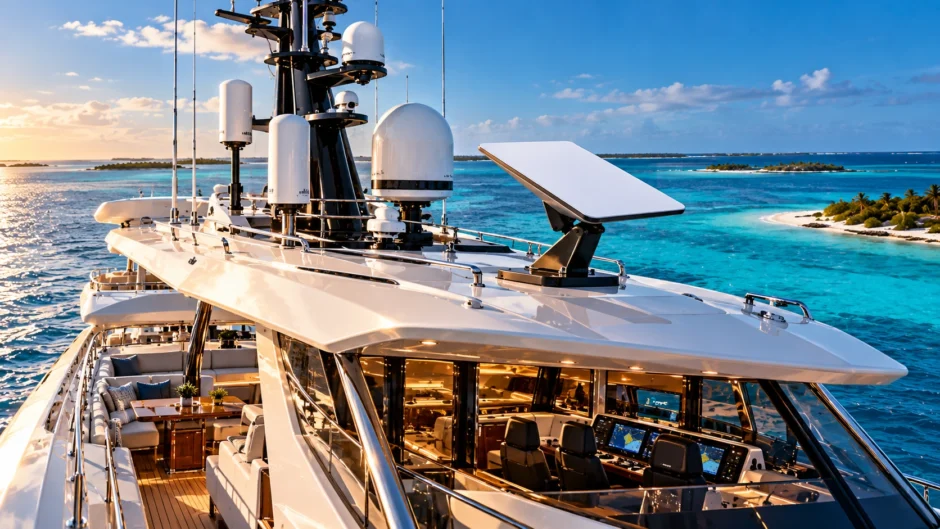
A multi-WAN router is designed to manage multiple wide-area network connections.
For a yacht, these connections could include:
- Cellular or 5G
- Satellite connectivity
- Marina Ethernet
- Secondary broadband
- Other available WAN services
The router can be configured to determine how traffic uses those connections.
Depending on the architecture, this can include:
- Primary and backup connections
- Automatic failover
- WAN prioritization
- Policy-based routing
- Traffic distribution
- Application-specific routing
- Bandwidth management
This becomes particularly valuable for yachts that regularly move between environments with different connectivity options.
What Is a Marine Bonding Router?
A bonding router takes the multi-WAN concept further by combining multiple connections into a coordinated connectivity architecture.
Rather than simply switching between connections, bonding technologies can be designed to use multiple connections together under supported configurations.
This can be useful when a yacht needs to make more effective use of several available connections.
However, bonding is not automatically required for every yacht.
The appropriate architecture depends on:
- Number of available connections
- Connection types
- Cruising routes
- Bandwidth requirements
- Application requirements
- Service plans
- Desired redundancy
- Existing network architecture
The objective should be to solve the yacht’s connectivity requirements rather than add complexity without a clear operational benefit.
Marine WiFi Router vs. Multi-WAN Router
The distinction can be simplified by looking at the role each device plays.
Marine WiFi Router
A marine WiFi router may be appropriate when the vessel needs a relatively straightforward network with wireless access and limited connectivity complexity.
It can be suitable for smaller vessels or simpler installations where one or a small number of connections are sufficient.
Marine Multi-WAN Router
A multi-WAN router becomes more relevant when a yacht has multiple internet sources and needs intelligent management of those connections.
The router can become the central point for failover, routing, segmentation, and bandwidth policies.
Marine Bonding Router
A bonding architecture may be considered when multiple connections need to be coordinated to improve the overall connectivity experience under appropriate technical and service conditions.
The choice should be based on the yacht’s actual requirements rather than the terminology used to market a product.
Why WiFi and Routing Should Be Designed Separately
One common source of confusion is assuming that the router and WiFi access points need to be the same device.
On a larger yacht, separating these functions can provide greater flexibility.
The router can manage:
- WAN connections
- Routing
- Firewall policies
- VLANs
- Failover
- Traffic policies
Dedicated access points can then provide wireless coverage throughout the vessel.
This allows access points to be positioned according to the yacht’s layout rather than according to where the router happens to be installed.
For a multi-deck yacht, that distinction can be important.
VLANs and Yacht Network Segmentation
A professional yacht router may also serve as an important component in network segmentation.
Instead of placing every connected device on the same network, VLANs can separate different categories of traffic.
A yacht could have separate network segments for:
- Guests
- Crew
- Administration
- AV and entertainment
- Security
- Operational technology
- IoT
- Network management
This helps control how different devices communicate with one another.
For example, guest devices should not automatically have access to network-management interfaces or operational systems simply because they are connected to the yacht’s WiFi.
The router, switches, and access points therefore need to work together as part of the network design.
A Yacht-Specific Example
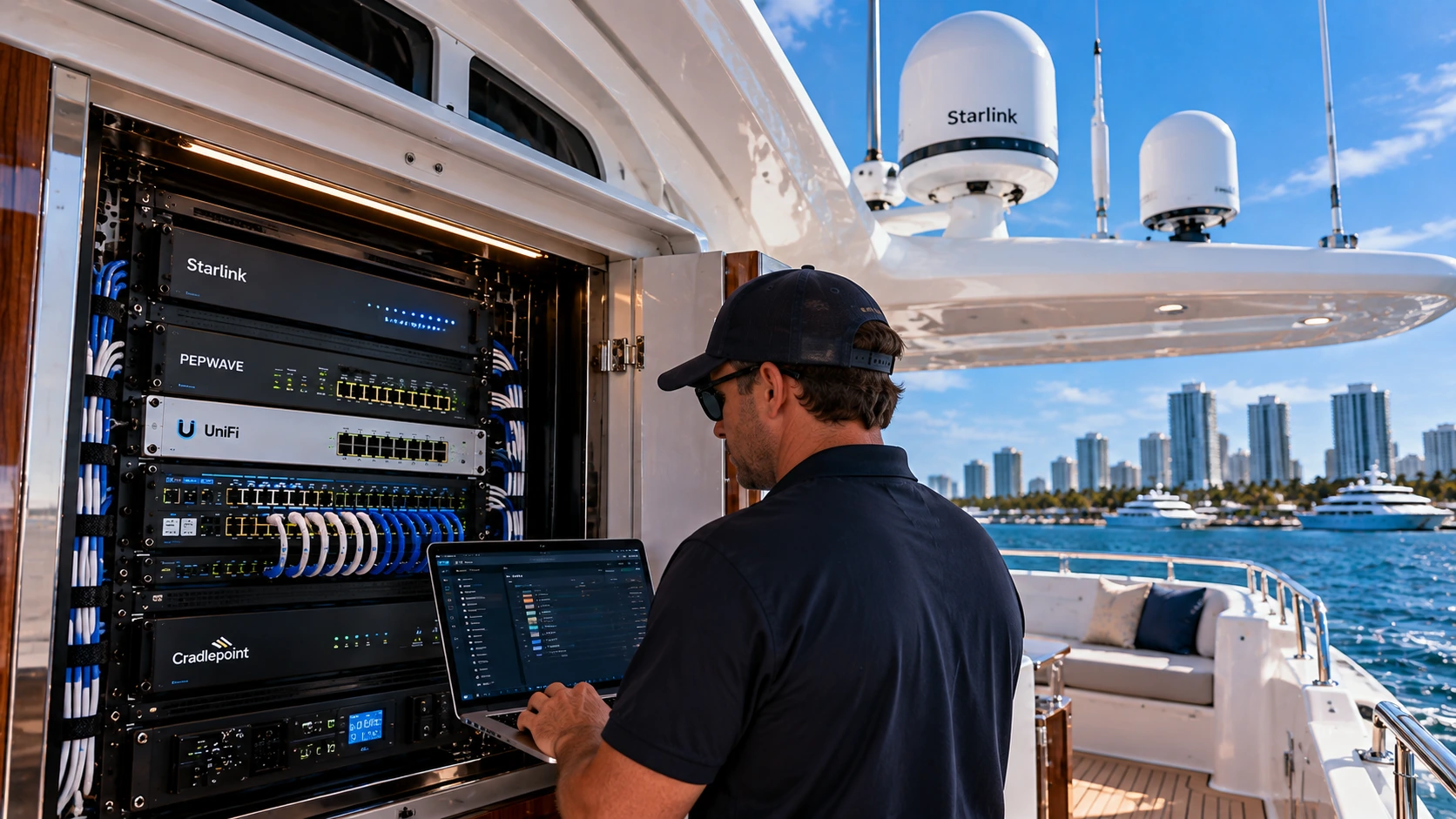
Consider a 116-foot charter yacht operating between Fort Lauderdale and Nassau.
The vessel may have:
- Multiple guest cabins
- Crew quarters
- Interior and exterior entertainment areas
- AV systems
- Security equipment
- Several dozen connected devices
- Cellular connectivity near shore
- Additional connectivity available while docked
- Satellite connectivity for appropriate offshore operation
A basic all-in-one WiFi router may not provide the architecture needed to manage all these requirements effectively.
A professional network could instead use a dedicated multi-WAN router, managed switches, multiple access points, VLAN segmentation, and appropriate WAN policies.
The router would manage connectivity and routing while strategically positioned access points provide wireless coverage throughout the yacht.
This architecture is fundamentally different from installing one high-powered wireless router and expecting it to cover the entire vessel.
What to Look for in a Yacht Router
When evaluating a router for a professionally managed yacht, consider the following capabilities.
Multiple WAN Connections
If the vessel uses more than one external connectivity source, the router should be capable of supporting the required WAN architecture.
Failover
The system should be able to respond appropriately when a primary connection becomes unavailable.
VLAN Support
Network segmentation can help separate guests, crew, AV, operational systems, and management traffic.
Firewall and Security Controls
The router should provide appropriate controls for managing traffic between network segments and external connections.
Bandwidth Management
Traffic policies can help manage limited or variable connectivity when many users are online simultaneously.
Remote Management
For professionally supported yachts, remote visibility can make troubleshooting and maintenance more practical.
Scalability
The network should have room to accommodate additional access points, connected devices, internet sources, and onboard technology as requirements change.
Integration
The router should work appropriately with the yacht’s switches, access points, satellite systems, cellular equipment, AV systems, and other network infrastructure.
How to Choose Between a Basic Router, Multi-WAN and Bonding
There is no single router architecture that is appropriate for every yacht.
A simpler router may be sufficient when:
- The vessel is smaller
- Network requirements are limited
- There are few users
- One primary connection is adequate
- There are limited onboard systems
A multi-WAN architecture becomes more relevant when:
- Multiple internet sources are available
- Failover matters
- The yacht moves between different connectivity environments
- Guest and crew demands are significant
- Network traffic needs to be controlled
Bonding may be worth evaluating when:
- Multiple connections need to work together
- Available connections vary significantly
- Consistent performance is important
- The applications justify the additional architecture
- The underlying services support the desired bonding configuration
The decision should follow the vessel’s operational requirements.
How Marine Data Solutions Works With Your Yacht

A yacht router project should begin with the vessel, its network, and its operating profile rather than with a particular hardware model.
1. Vessel and Network Review
Marine Data Solutions starts by understanding the yacht, its size, existing network, cruising regions, onboard systems, users, and mission.
The team reviews the current router, switches, access points, connectivity sources, and upcoming project requirements.
2. Connectivity and Architecture Assessment
The available WAN connections are evaluated alongside the onboard network.
The team can determine whether a simpler router, multi-WAN architecture, or more advanced connectivity approach is appropriate for the vessel.
3. Network Design
The network architecture is developed around the yacht’s requirements.
This can include routing, VLANs, firewall policies, WAN failover, bandwidth management, switching, access points, and integration with other onboard systems.
4. Installation and Integration
During the appropriate yard or dockside window, equipment can be installed and integrated with the vessel’s existing infrastructure.
5. Testing, Crew Handover and Ongoing Support
The system is tested across relevant network segments and operating conditions.
Documentation and crew handover help the onboard team understand the network and its basic operating procedures.
As the yacht adds connected systems, changes cruising regions, or modifies its connectivity services, the network may need to evolve.
Ongoing support can help keep the router and wider network architecture aligned with those changes.
What a Yacht Router Review Should Evaluate
Before replacing a router, review the complete network.
Important questions include:
- How many WAN connections are currently available?
- Which connections are primary and backup?
- Does the yacht need failover?
- Are guest and crew networks separated?
- How many access points are installed?
- Is the existing router capable of supporting the network?
- Are VLANs required?
- How much bandwidth does the yacht typically consume?
- Are AV and operational systems isolated appropriately?
- Is remote management available?
- Does the network have capacity for future expansion?
- What is the upcoming yard or refit window?
This prevents a common problem: replacing a router without addressing the network architecture around it.
Request a Yacht Network Vessel Review
If you manage a 70–200+ ft yacht and are considering a marine WiFi router, multi-WAN router, or broader network upgrade, a vessel-specific review can help determine which architecture fits the yacht.
Tell the Marine Data Solutions team your vessel length, cruising region, role, mission, existing network equipment, available connectivity sources, and desired work window.
The team can review the initial requirements and discuss what should be addressed before equipment is selected.
What Happens Next
- Submit your vessel and project information.
- The Marine Data Solutions team reviews the initial requirements.
- A planning conversation is scheduled.
- The team identifies the appropriate next steps for design, equipment, installation, or support.
Planning a Smaller-Boat or DIY Router Installation
If you operate a smaller vessel or are looking for equipment for a DIY installation, explore the available options through the Marine Data Solutions shop.
The Yacht Network Vessel Review is intended for professionally managed 70–200+ ft yachts.
For larger yachts with multiple users, multiple connectivity sources, complex onboard systems, or upcoming refit work, a vessel-specific network review can help establish the appropriate architecture before purchasing equipment.
Frequently Asked Questions About Marine WiFi Routers
What is a marine WiFi router?
A marine WiFi router is a networking device designed to provide routing and, depending on the equipment, wireless connectivity onboard a vessel. The appropriate capabilities depend on the size and complexity of the yacht’s network.
What is the difference between a yacht router and a multi-WAN router?
A basic yacht router may manage a relatively simple network and one or limited external connections. A multi-WAN router is designed to manage multiple WAN connections and can support functions such as failover, routing policies, and traffic management.
Does a large yacht need a marine multi-WAN router?
Not every large yacht needs multi-WAN. The decision depends on the number of connectivity sources, cruising profile, reliability requirements, users, onboard systems, and network architecture.
What is a marine bonding router?
A marine bonding router can coordinate multiple connectivity sources as part of a bonding architecture. Depending on the technology and service configuration, multiple connections may be used together rather than simply selecting one connection at a time.
Should the yacht router also provide WiFi?
It can, but larger yachts often benefit from separating routing from wireless access. A dedicated router can manage WAN connections and network policies while strategically positioned access points provide WiFi throughout the vessel.
How do I know which yacht router I need?
Start with the vessel’s requirements rather than a specific product. Review the number of WAN connections, users, access points, VLANs, bandwidth requirements, onboard systems, cruising regions, and future expansion needs. A professional vessel review can then determine the appropriate architecture.
Request a Yacht Network Vessel Review
For a 70–200+ ft yacht, selecting a router is a network architecture decision—not simply a hardware purchase.
The right approach may involve a marine WiFi router, dedicated multi-WAN router, bonding architecture, separate wireless access points, managed switching, VLANs, or a combination of these components.
If you are preparing for a refit, new build, yard period, or network upgrade, provide your vessel size, cruising region, mission, current network equipment, connectivity sources, and desired work window.
Marine Data Solutions can review the requirements and discuss the appropriate next step for your yacht.
Request a Yacht Network Vessel Review
Complete the form below to schedule a 20–30 minute consultation with a Marine Data Solutions yacht network and communications specialist.
Best suited for professionally managed 70–200+ ft yachts planning a router, network, or connectivity upgrade as part of a refit, new build, yard period, or network modernization project