
- Upgrade Your Yacht’s Offshore Communications
- Why Marine Satellite Communications Matter Offshore
- What a Yacht Satellite Communications System Can Include
- Designing Communications Around the Yacht, Not Just the Equipment
- How We Work With Your Yacht
- Marine Satellite Communications Should Work With the Rest of the Yacht
- Planning Your Next Communications Upgrade?
- Planning a Yacht Communications Upgrade Around Your Yard Window
- Marine Satellite Communications: When Should You Request a Vessel Review?
- Request a Vessel Communications Review
- Marine Satellite Communications FAQs
- Request a Vessel Communications Review
- Related Articles:
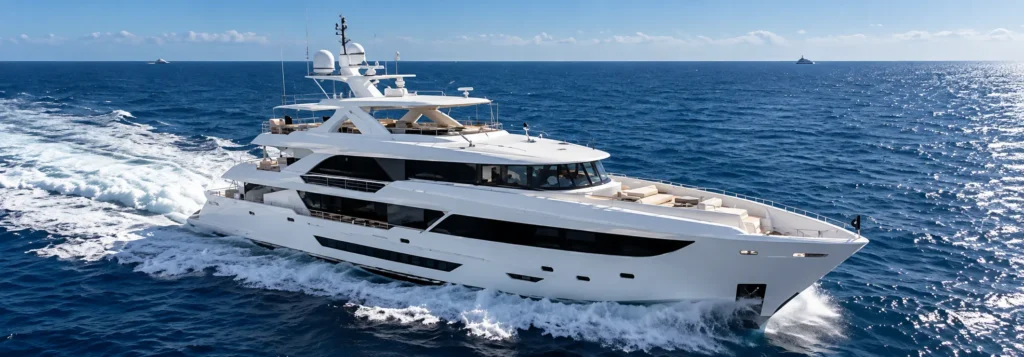
For a 70–200+ ft private, charter, or business yacht, communications are more than an internet connection. Captains and crews may need reliable connectivity for operations, weather information, guest services, business communications, crew coordination, and access to shore-based support while cruising between marinas and offshore destinations.
When a yacht leaves reliable terrestrial coverage, the communications system becomes part of the vessel’s operational infrastructure.
Marine satellite communications can provide the offshore connectivity layer needed when cellular and marina Wi-Fi are no longer dependable. The challenge is designing that system around the yacht’s size, routes, usage requirements, onboard network, and operational priorities.
If you are planning a communications upgrade, refit, new build, or yard period, a vessel-specific review can help determine what architecture makes sense before equipment is selected or installed.
Running a smaller boat or planning a DIY install? Start with equipment options at marinedatasolutions.com/shop/
Marine Data Solutions and Concord Marine Electronics have delivered more than 400 complex yacht and commercial vessel internet and communications installations and 170 new-build electronics projects since 1988, with 24/7 support for captains and crews who depend on their systems offshore. Our core engineering and support team operates from Fort Lauderdale’s Safe Harbor Lauderdale Marine Center, supporting projects across the United States, Bahamas, Caribbean and Mediterranean.
Upgrade Your Yacht’s Offshore Communications
If your current connectivity becomes unreliable once you leave the dock, it may be time to review the entire communications architecture—not just replace a piece of equipment.
Tell us your vessel size, cruising regions, current setup, and upcoming yard window. Our team can review your requirements and help identify the right path for satellite, cellular, and onboard network integration as part of a Vessel Communications Review.
Why Marine Satellite Communications Matter Offshore
A yacht can have excellent connectivity in a marina and still experience significant limitations once it moves offshore.
For a captain, the problem is not simply slower internet. Unreliable communications can affect multiple parts of the operation:
- Crew communication and coordination
- Weather and routing information
- Access to shore-based management teams
- Charter guest connectivity
- Business operations conducted onboard
- Remote technical support
- Vessel monitoring and connected systems
- Communication with vendors, yards, and agents
For charter yachts, connectivity can also become part of the guest experience. Guests increasingly expect the ability to remain connected while cruising, working remotely, streaming content, and communicating with family or colleagues.
A professional satellite communications system therefore needs to be considered as part of the yacht’s overall network—not as an isolated antenna mounted on the mast.
What a Yacht Satellite Communications System Can Include
The right architecture depends on the vessel and its operating profile. A professional marine communications installation may combine several connectivity technologies rather than relying on one connection.
Satellite Connectivity
Satellite communications can provide a primary or supplemental offshore connection when terrestrial services are unavailable.
Depending on the project, this can involve different satellite technologies, antennas, modems, network equipment, and service plans.
Cellular Connectivity
When the yacht is within coastal cellular coverage, 4G or 5G can provide an efficient connectivity option.
A properly designed system can manage transitions between cellular and satellite connectivity based on location and operational requirements.
Wi-Fi and Onboard Networking
The satellite connection still has to reach the people and systems that need it.
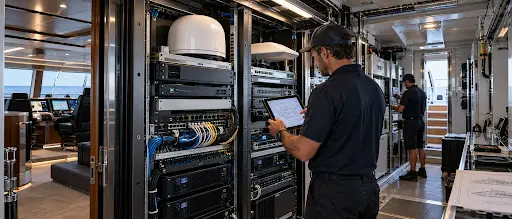
That means the onboard network—including Wi-Fi access points, switching, routing, firewalling, and network segmentation—needs to be designed to support the vessel’s requirements.
Network Management
Professional yachts may have multiple users, departments, devices, and connected systems competing for bandwidth.
Network management can help prioritize important operational traffic while controlling bandwidth-intensive guest or entertainment use.
Designing Communications Around the Yacht, Not Just the Equipment
Two yachts can be the same length and still require very different communications architectures.
A charter yacht operating primarily in the Bahamas may have different requirements from a private yacht spending months in the Mediterranean and then crossing to the Caribbean.
For example, a 116-foot charter yacht running weekly trips between Fort Lauderdale and Nassau will usually prioritize guest streaming, crew messaging and remote management access along the Florida–Bahamas corridor, while a 55-meter private yacht spending months in the Med and then crossing to the Caribbean may require different satellite plans, antenna choices and onboard network policies to match a longer-range cruising profile.
The system design should consider:
Vessel Size and Layout
A 70 ft yacht and a 180 ft yacht have very different network coverage, equipment-room, cabling, and infrastructure requirements.
Cruising Routes
Coverage expectations and available terrestrial services change as the yacht moves between regions.
Mission
Private use, charter operations, and business use can create very different bandwidth, reliability, and user requirements.
Guest and Crew Demand
The network may need to support simultaneous video calls, streaming, operational applications, smartphones, laptops, smart TVs, and connected onboard systems.
Redundancy Requirements
For some vessels, having more than one connectivity path can be important when a primary service becomes unavailable or unsuitable.
How We Work With Your Yacht
A professional marine satellite communications project should begin with the vessel and its operating requirements—not with a shopping list of hardware.
1. Vessel + Route Review
Marine Data Solutions starts by understanding the yacht, its size, onboard systems, cruising regions, typical routes, and mission.
We also review how the vessel currently connects to the internet and where the existing system creates operational or user-experience problems.
2. Communications System Design
The next step is developing an architecture around the vessel’s requirements.
This can include satellite, cellular, onboard networking, routing, Wi-Fi, switching, network security, and connectivity management.
3. Yard or Dockside Installation
Installation is coordinated around the yacht’s physical infrastructure and available work window.
Equipment placement, cabling, rack infrastructure, antennas, power requirements, and integration with existing systems all need to be considered before installation begins.
4. Testing + Crew Handover
After installation, the system is tested under real operating conditions.
Documentation and crew handover help ensure the captain and engineering team understand how the system works and what to do when connectivity conditions change.
5. Ongoing Support
Marine communications systems operate in an environment where routes, services, equipment, and onboard requirements change.
Ongoing technical support can help keep the system aligned with the yacht as its operating profile evolves.
Marine Satellite Communications Should Work With the Rest of the Yacht
A satellite connection is only one component of a larger communications environment.
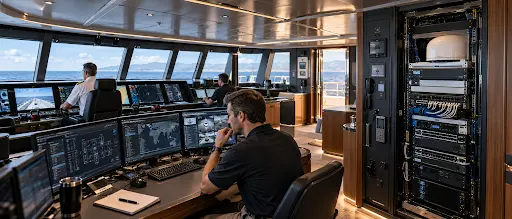
For larger yachts, the real value comes from integrating connectivity with the onboard network so that users and systems receive an appropriate experience regardless of how the vessel is connected.
For example, the system may need to accommodate:
- Crew and guest networks
- Business communications
- Voice and video calls
- Streaming and entertainment
- Navigation-related data
- Remote monitoring
- Security systems
- Engineering systems
- Administrative applications
Separating and prioritizing these types of traffic can help prevent a single high-bandwidth activity from affecting the rest of the vessel.
Planning Your Next Communications Upgrade?
If your yacht is 70–200+ ft and you need dependable communications across offshore routes, the next step is to review the vessel rather than guess at the equipment.
Request a Vessel Communications Review to discuss your yacht, routes, current system, requirements, and upcoming work window with the sales team.
Planning a Yacht Communications Upgrade Around Your Yard Window
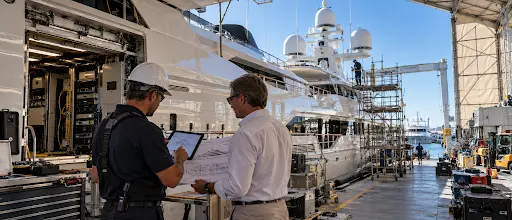
A communications project is often easiest to execute when coordinated with an upcoming refit, maintenance period, or new-build schedule.
Planning early provides an opportunity to review:
- Existing antenna locations
- Equipment-room capacity
- Cable pathways
- Power requirements
- Network infrastructure
- Existing communications equipment
- Integration requirements
- Service activation timing
- Testing requirements
This is particularly important when the yacht has a limited yard window. Discovering infrastructure requirements after installation has already started can create unnecessary delays and additional costs.

Marine Satellite Communications: When Should You Request a Vessel Review?
A professional review makes sense if you are:
- Operating a 70–200+ ft yacht offshore
- Preparing for an extended cruising season
- Planning a refit or communications upgrade
- Building or commissioning a new yacht
- Experiencing unreliable offshore connectivity
- Managing a charter yacht with high guest bandwidth demand
- Replacing aging satellite communications equipment
- Trying to integrate satellite and cellular services
- Planning an upcoming yard period
The goal is not simply to install another satellite antenna. The goal is to determine what communications architecture makes sense for your yacht, routes, users, and operational requirements.
Request a Vessel Communications Review
If you operate a 70–200+ ft yacht and are evaluating marine satellite communications, start with a vessel-specific conversation.
Complete the project inquiry with your vessel name, length, cruising region, role, mission, desired work window, and estimated project budget. This gives the Marine Data Solutions team enough context to determine whether the project is a good fit and what should be reviewed first.
A typical planning call can cover your current communications setup, cruising profile, connectivity requirements, upcoming yard period, and potential system architecture.
From there, the next step can be determined based on the vessel and project requirements.
Marine Satellite Communications FAQs
What are marine satellite communications?
Marine satellite communications use satellite networks to provide connectivity to vessels operating beyond reliable terrestrial cellular or marina internet coverage. On larger yachts, satellite connectivity can be integrated into a broader onboard communications and network architecture.
Do yachts need satellite communications if they already have 5G?
Not necessarily in every operating situation. Cellular connectivity can be excellent when the yacht is within coverage, but offshore routes can take the vessel beyond reliable terrestrial networks. A combination of connectivity options may provide a more appropriate architecture for yachts with demanding operating profiles.
Can satellite communications support charter yachts?
Yes. Satellite connectivity can be incorporated into charter yacht communications systems where reliable offshore connectivity is important for guests, crew, operations, and business requirements.
Can marine satellite communications work with an existing yacht network?
Yes, depending on the existing infrastructure. Satellite connectivity can be integrated with routers, switches, Wi-Fi, firewalls, and other network components as part of a broader communications architecture.
How much does a yacht satellite communications system cost?
There is no single price because system requirements vary significantly by vessel size, route, service requirements, existing infrastructure, equipment, installation complexity, and desired redundancy. A vessel review is the better starting point for developing a project scope and budget.
What information should I provide before planning a communications project?
Useful information includes the yacht’s length, vessel name, cruising regions, current communications setup, mission, primary users, upcoming yard or dockside work window, and estimated project budget.
Request a Vessel Communications Review
Complete the form below to schedule a 20–30 minute consultation with a Marine Data Solutions network specialist.