

- Need Help Choosing Yacht Satellite Internet?
- Why There Is No Single Best Satellite System for Every Yacht
- Starlink for Yacht Connectivity
- OneWeb and Low-Earth-Orbit Satellite Connectivity
- Traditional VSAT for Yachts
- Matching Satellite Internet to the Cruising Profile
- Why Redundancy Matters on a Yacht
- Satellite Connectivity and the Yacht's Onboard Network
- Antenna Placement and Vessel Integration
- Bandwidth Is Not the Same as Reliability
- Request a Yacht Satellite Connectivity Review
- How Marine Data Solutions Works With Your Yacht
- What to Evaluate Before Choosing Yacht Satellite Internet
- Request a Yacht Satellite Connectivity Review
- What Happens Next
- Planning a Smaller-Boat or DIY Satellite Installation
- Frequently Asked Questions About Satellite Internet for Yachts
- Request a Yacht Satellite Connectivity Review
- Request a Yacht Satellite Connectivity Review
- Related Articles:
This guide is for professionally managed 70–200+ ft private and charter yachts with full-time captains, engineers/ETOs, yacht managers, or owner representatives.
If you run a smaller boat or plan a DIY installation, start with equipment options in the Marine Data Solutions shop.
For a professionally managed yacht, finding the best satellite internet for yachts is not simply a matter of choosing the service with the highest advertised download speed.
A 70–200+ ft yacht may operate between marinas, coastal cruising areas, islands, and offshore passages. It may need connectivity for guests, crew, business operations, entertainment systems, vessel management, remote support, and other onboard services.
Different satellite technologies can serve different operating profiles.
Starlink has changed expectations for high-bandwidth connectivity at sea. OneWeb represents another low-Earth-orbit satellite option that can be evaluated for appropriate maritime applications. Traditional VSAT remains relevant for vessels that require established maritime satellite architectures, service options, redundancy, and operational characteristics that may differ from newer systems.
The right choice depends on the yacht.
This guide compares Starlink, OneWeb, and VSAT from a vessel and cruising-profile perspective so owners, captains, managers, and engineers can better understand what should be evaluated before selecting a satellite system.
The Yacht Satellite Connectivity Review is intended for professionally managed 70–200+ ft yachts. If you operate a smaller vessel or are planning a DIY satellite installation, please use the Marine Data Solutions shop instead of requesting a review.
Running a smaller boat or planning a DIY installation?
Start with equipment options at the Marine Data Solutions shop.
Marine Data Solutions has delivered complex yacht and commercial vessel internet and communications installations on professionally managed 70–200+ ft yachts since 2016+.
Our team is based in Fort Lauderdale and supports vessels operating across the United States, Bahamas, Caribbean, and Mediterranean.
Need Help Choosing Yacht Satellite Internet?
Why There Is No Single Best Satellite System for Every Yacht
Satellite connectivity is only one part of a yacht’s communications architecture.
The appropriate solution can depend on:
- Vessel size
- Cruising routes
- Time spent offshore
- Number of users
- Guest bandwidth requirements
- Crew requirements
- Business use onboard
- Operational systems
- Required uptime
- Existing communications equipment
- Available cellular connectivity
- Redundancy requirements
- Antenna and installation constraints
- Service-plan requirements
- Budget and lifecycle considerations
A charter yacht that spends most of its time in the Bahamas may have very different requirements from a private yacht making extended offshore passages.
Likewise, a yacht that needs connectivity primarily for guest streaming may have different priorities from a vessel where communications are also important for operational and business functions.
The question is therefore not simply “Which satellite system is fastest?”
The better question is: “Which satellite architecture fits the yacht’s mission, routes, and operational requirements?”
Starlink for Yacht Connectivity
Starlink has become an important option for high-bandwidth maritime connectivity.
Its low-Earth-orbit architecture can provide broadband performance that is particularly attractive for applications such as:
- Guest streaming
- Video conferencing
- Cloud applications
- Remote work
- General internet access
- Crew communications
- Large data transfers
For yachts where high bandwidth is a priority, Starlink can be an important component of the communications architecture.
However, selecting Starlink still requires consideration of the vessel’s operating profile, service configuration, antenna requirements, network integration, and backup strategy.
A yacht should not necessarily depend on a single connectivity source simply because that source provides high speeds under suitable conditions.
OneWeb and Low-Earth-Orbit Satellite Connectivity
OneWeb is another low-Earth-orbit satellite network that can be considered for maritime connectivity.
Like other LEO architectures, the technology is designed around a constellation of satellites operating much closer to Earth than traditional geostationary satellite systems.
For professionally managed vessels, OneWeb may be relevant where service availability, enterprise requirements, coverage, equipment architecture, and commercial service options align with the yacht’s operating profile.
The important point is that a yacht should be evaluated based on the actual service and equipment configuration available to that vessel and route.
Availability, terminal options, service plans, geographic coverage, and commercial terms can change, so these factors should be confirmed during the project design process rather than assumed from the underlying satellite technology alone.
Traditional VSAT for Yachts
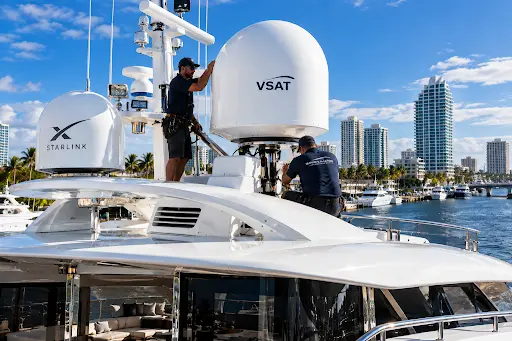
VSAT has been a foundational technology in maritime satellite communications for many years.
Traditional VSAT systems typically use larger stabilized antennas and geostationary satellite networks to provide connectivity over wide operating areas.
For certain professionally managed yachts, VSAT can remain relevant because of its established maritime infrastructure, service options, antenna configurations, and ability to form part of a broader communications architecture.
VSAT may be particularly relevant when a vessel has requirements extending beyond simply maximizing internet speed.
Depending on the service and system architecture, considerations can include:
- Coverage
- Service availability
- Dedicated or managed bandwidth
- Network management
- Voice services
- Operational communications
- Redundancy
- Existing onboard infrastructure
- Contract and service requirements
The appropriate comparison is therefore not simply LEO versus VSAT. It is about matching the architecture to the yacht’s actual requirements.
Matching Satellite Internet to the Cruising Profile
The best satellite internet for a yacht depends heavily on where and how the vessel operates.

Profile 1: Coastal and Bahamas Charter Yacht
Consider a 116-foot charter yacht operating between Fort Lauderdale, Nassau, and other Bahamas destinations.
The vessel may have access to cellular connectivity during portions of the trip and may use marina internet when docked.
For this profile, a high-bandwidth LEO service can be attractive for offshore or coastal operation, while cellular and shore-based connections can provide additional connectivity where available.
A multi-WAN architecture can help integrate those sources rather than requiring the crew to manually switch between them.
Profile 2: Private Yacht With Extensive Offshore Cruising
A private yacht spending substantial time offshore may place greater emphasis on connectivity availability, route coverage, redundancy, and the ability to maintain communications beyond cellular coverage.
The design may therefore involve multiple satellite options or a combination of satellite and other WAN sources.
For this type of vessel, the satellite system should be evaluated as part of the overall communications architecture.
Profile 3: High-End Yacht With Significant Business Use
Some yachts function as temporary offices for owners, executives, family offices, or businesses.
The network may need to support:
- Video conferencing
- Cloud applications
- Secure remote access
- Large file transfers
- Voice communications
- Guest entertainment
- Crew systems
In this situation, raw download speed is only one consideration.
Network segmentation, bandwidth management, security, failover, and predictable service behavior may be equally important.
Profile 4: Large Yacht With Existing VSAT Infrastructure
A yacht that already has an established VSAT installation may not need to replace everything simply because a newer satellite technology is available.
The appropriate strategy could involve adding another connectivity source and integrating it into the existing network.
This can preserve useful existing infrastructure while adding additional bandwidth or redundancy.
Why Redundancy Matters on a Yacht
A yacht’s connectivity environment can change quickly.
The vessel may move:
- Out of cellular coverage
- Away from a marina
- Between satellite service areas
- Into areas with changing weather or network conditions
- Between different cruising regions
For a yacht where connectivity is important, relying on one connection may create unnecessary operational risk.
A professionally designed architecture can combine satellite connectivity with other WAN sources, such as:
- Cellular/5G
- Marina Ethernet
- Secondary satellite services
- Other available broadband connections
The network can then determine how those connections are used based on the vessel’s configuration.
This is where satellite selection and network engineering become closely connected.
Satellite Connectivity and the Yacht’s Onboard Network
Installing a satellite terminal does not automatically solve the yacht’s connectivity requirements.
The satellite system has to connect to the vessel’s network.
That network may include:
- Routers
- Multi-WAN equipment
- Managed switches
- WiFi access points
- Firewalls
- VLANs
- AV systems
- Crew networks
- Guest networks
- Operational technology
A well-designed architecture separates these functions while allowing the appropriate systems to access available internet connections.
For example, guest streaming may consume substantial bandwidth while crew systems and operational applications need consistent access to the network.
The satellite terminal provides the connection, but the onboard network determines how that connection is distributed.
Antenna Placement and Vessel Integration
Satellite equipment also needs to be considered from a physical installation perspective.
Large yachts have complex structures and limited equipment locations.
A satellite antenna may need to be integrated with existing:
- Satellite antennas
- Radar
- Communications equipment
- Masts
- HVAC equipment
- Solar equipment
- Other deck hardware
The installation also needs to account for cable runs, equipment-room locations, power, network connectivity, maintenance access, and the vessel’s aesthetic requirements.
For a new build or major refit, these issues are best addressed before equipment selection and installation.
Bandwidth Is Not the Same as Reliability
A satellite system can offer impressive bandwidth while still being only one component of a reliable yacht connectivity strategy.
Reliability can depend on:
- Satellite coverage
- Service configuration
- Antenna visibility
- Vessel location
- Network congestion
- Weather and environmental conditions
- Service interruptions
- Hardware configuration
- Backup connectivity
This is why a professional yacht communications review should consider both performance and resilience.
A slower backup connection can sometimes be operationally more valuable than an additional high-speed connection if it remains available when the primary connection is unavailable.
Request a Yacht Satellite Connectivity Review
For a 70–200+ ft yacht, choosing satellite internet should begin with the vessel’s mission, routes, users, and operational requirements, not a generic ranking of satellite providers.
Starlink, OneWeb, and VSAT each represent different approaches to maritime satellite connectivity. In some cases, the best architecture may involve one primary system. In others, combining satellite services with cellular, shore-based connectivity, and intelligent WAN management may provide a more appropriate solution.
If you are planning a refit, new build, yard period, or satellite communications upgrade, provide your vessel size, cruising region, mission, current communications setup, and desired work window.
Marine Data Solutions can review the requirements and discuss the appropriate next step for your yacht.
How Marine Data Solutions Works With Your Yacht
A satellite connectivity project should begin with the yacht’s operating requirements rather than a particular satellite brand.
1. Vessel and Route Review
Marine Data Solutions starts by understanding the yacht, its size, mission, cruising regions, typical routes, existing communications equipment, and expected usage.
The team can identify where connectivity is most critical and how the yacht currently manages communications.
2. Communications Architecture Review
Existing satellite, cellular, shore-based, and network infrastructure is evaluated together.
The goal is to determine whether the yacht needs a new satellite system, an additional connectivity source, network changes, or a broader communications redesign.
3. Satellite and Network Design
The appropriate architecture is developed around the vessel’s requirements.
This can include satellite terminals, antennas, routers, multi-WAN integration, network segmentation, switching, WiFi, and bandwidth policies.
4. Yard or Dockside Installation
Equipment can be installed and integrated during the appropriate yard or dockside window.
Existing systems can be evaluated for reuse where appropriate.
5. Testing and Crew Handover
The completed system is tested and documented.
Crew handover helps ensure the onboard team understands the system and its basic operating procedures.
6. Ongoing Support
Satellite services, hardware, routes, and onboard requirements can change.
Ongoing support can help keep the communications architecture aligned with the yacht’s operating profile.

What to Evaluate Before Choosing Yacht Satellite Internet
Before deciding which satellite system is best, evaluate:
- Vessel size
- Cruising regions
- Offshore time
- Typical routes
- Number of users
- Guest bandwidth requirements
- Crew requirements
- Business use
- Operational systems
- Current satellite equipment
- Cellular coverage
- Existing network architecture
- Required redundancy
- Antenna locations
- Available equipment space
- Power requirements
- Yard or refit schedule
- Service-plan requirements
- Total project budget
This information provides the context needed to compare satellite technologies meaningfully.
Request a Yacht Satellite Connectivity Review
If you manage a 70–200+ ft yacht and are evaluating Starlink, OneWeb, VSAT, or a combination of satellite and other connectivity sources, a vessel-specific review can help determine what architecture makes sense.
Tell the Marine Data Solutions team your vessel length, cruising region, role, mission, existing satellite equipment, current connectivity sources, and desired work window.
The team can review the requirements and discuss whether the project is a fit and what should be evaluated first.
What Happens Next
- Submit your vessel and project information.
- The Marine Data Solutions team reviews the initial requirements.
- A planning conversation is scheduled.
- The team identifies the appropriate next steps for satellite selection, network design, installation, or support.
Planning a Smaller-Boat or DIY Satellite Installation
Not every vessel requires a professionally engineered satellite communications architecture.
If you operate a smaller boat or are looking for equipment for a DIY installation, explore available equipment options through the Marine Data Solutions shop.
For larger yachts, complex refits, charter operations, or vessels with multiple connectivity sources, a professional vessel review can help determine the appropriate satellite and network architecture before equipment is selected.
Frequently Asked Questions About Satellite Internet for Yachts
What is the best satellite internet for yachts?
There is no single best option for every yacht. Starlink, OneWeb, and traditional VSAT can each make sense depending on the vessel’s cruising profile, bandwidth requirements, coverage needs, existing infrastructure, redundancy requirements, and operating mission.
Is Starlink the best satellite internet option for a yacht?
Starlink can be an attractive option for yachts that prioritize high-bandwidth broadband and where the service is appropriate for the vessel’s operating profile. However, the best solution may involve Starlink alongside cellular, shore-based connectivity, another satellite system, or an existing VSAT installation.
Is OneWeb available for yacht satellite internet?
OneWeb-based maritime connectivity can be available through appropriate commercial service providers and equipment configurations. Availability, terminal options, service plans, and coverage should be verified for the specific yacht and cruising regions during project planning.
Is VSAT still useful for yachts?
Yes. VSAT remains relevant for certain professionally managed vessels because of its established maritime ecosystem, service options, coverage characteristics, and role in broader communications architectures. Whether it is appropriate depends on the yacht’s specific requirements.
Can a yacht use Starlink and VSAT together?
A yacht can potentially integrate multiple satellite systems into a broader network architecture. The network can use multiple WAN sources according to its routing, failover, and traffic-management configuration.
Should a yacht have more than one satellite connection?
Not necessarily. The appropriate level of redundancy depends on the vessel’s mission, routes, operational requirements, existing cellular coverage, shore connectivity, and consequences of losing the primary connection. A professional review can determine whether additional satellite redundancy is justified.
Request a Yacht Satellite Connectivity Review
For a 70–200+ ft yacht, selecting satellite internet is a communications architecture decision—not simply a hardware purchase.
The right approach may involve Starlink, OneWeb, VSAT, cellular connectivity, shore-based internet, multi-WAN integration, or a combination of these components.
If you are preparing for a refit, new build, yard period, or satellite communications upgrade, provide your vessel size, cruising region, mission, current communications equipment, connectivity sources, and desired work window.
Marine Data Solutions can review the requirements and discuss the appropriate next step for your yacht.
Request a Yacht Satellite Connectivity Review
Complete the form below to schedule a 20–30 minute consultation with a Marine Data Solutions yacht satellite connectivity and communications specialist.
Best suited for professionally managed 70–200+ ft yachts evaluating Starlink, OneWeb, VSAT, or a broader satellite connectivity upgrade as part of a refit, new build, yard period, or network modernization project